Bill Ready at Pinterest Presents: The best technology should make our lives bigger
September 17, 2026

Remarks delivered at Pinterest Presents annual marketing summit
We are living through one of the most monumental changes in how people use technology in our lifetimes. AI is reshaping nearly everything. But to what end? AI is like a powerful genie. It’s good at granting wishes, but maybe not always in the ways you’d expect. So, it’s really important that we are all very intentional about what we ask it to do.
At Pinterest, we know where we stand on this. We believe that AI should help people live richer, more fulfilling lives, not keep them glued to a screen. Because the best thing you can find online is a reason to go offline.
I built my career in Silicon Valley because I believe technology can make people's lives better. That belief is the reason Pinterest exists. And it's the reason we've spent the last several years pointing this life-changing technology at exactly that task: making people's lives better, offline and in the real world. We're using AI to help people go from an idea to an action. To find the look. Plan the room. Cook the dish. Take the trip. This is how AI can be an enabler of human creativity, rather than a replacement for it.
Years ago, we made a choice to build a different kind of platform. We made accounts private-only for people under 16, because it isn’t safe for children to be contacted by strangers online. We changed what our algorithm rewards: not more time spent, but time well spent instead. We became a leading voice for phone-free schools, and built prompts into our own app telling students to come back after school. We’ve supported thoughtful legislation to protect kids online.
And as AI arrived, we held the same line: it’s designed for safety from the start. And we restrict people under 18 from certain AI features. Plenty of people said these decisions would hurt our ability to grow with young people. We made the harder choice anyway because it was the right thing to do.
We deeply believed that we could build a good business rooted in positivity. That we could do well by doing good, and that there would be real consumer demand for a safer, more positive space. That bet is paying off.
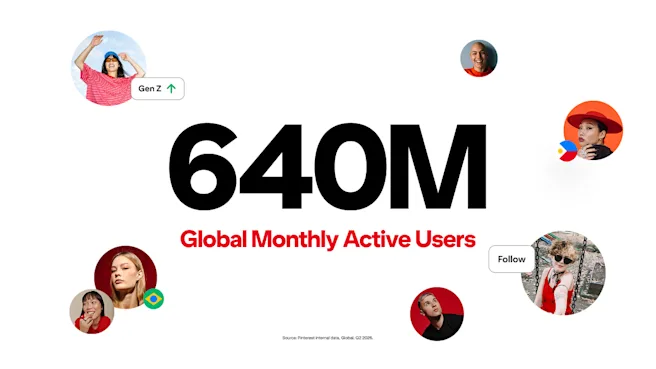
640 million people now come to Pinterest every month. We've reached record users for 12 straight quarters.1 Gen Z now represents more than half of our audience and is our largest, fastest growing demographic.2
Consumers are ready for a real alternative to the attention-hacking that has come at such great cost to them. People know when an experience is designed for them, and when it's just designed to harvest their attention. Whether it is designed to be additive, or addictive. And they’re choosing accordingly.
You can see it well beyond Pinterest. Parents, schools, and young people themselves are pushing back. This isn’t just a trend. It’s a verdict.
So let's be honest about what people are rejecting. Somewhere along the way, this industry lost sight of its purpose. Success got measured by how much of people's attention could be captured, not by whether they got anything worthwhile out of it. And an entire generation of young people bore the cost.
For more than a decade, young people have been treated as test subjects in the largest social experiment in history. The costs of that experiment are only now coming into full view: in classrooms, at our kitchen tables, and yes, in courtrooms too.
The biggest platforms in this industry knew what their products were doing to kids, and they kept optimizing for engagement anyway. Because it was working.
And look, parental controls and screen-time limits may help at the margins. But thicker filters don’t make cigarettes less addictive. And guardrails won’t fix a business model built to keep people glued to a screen.
Now, with AI, they're running the same play again, faster and at a scale that will make the last decade look quaint. Except this time, the product doesn't just decide what a kid looks at. It talks back, pretending to be a friend, and competing to replace real human connection.
I’m a parent. I know many of you are too. And I don’t accept that. Pinterest has never accepted that. And you don't have to, either.
You didn't build this. And nobody in this room wants to advertise in a place that harms kids. You just haven't had an alternative.
If you wanted reach, you invested in the biggest platforms, whether or not you liked how they operated. Now the old paths to traffic are disappearing. And you're being asked to grow in an AI-native world, with less clarity than ever about where your next dollar should go. But your customers are moving on.
And I'm not here to ask you to do the right thing at the expense of your business. We’re here to prove it’s possible to have a good business by doing the right thing, for us and for all of you.
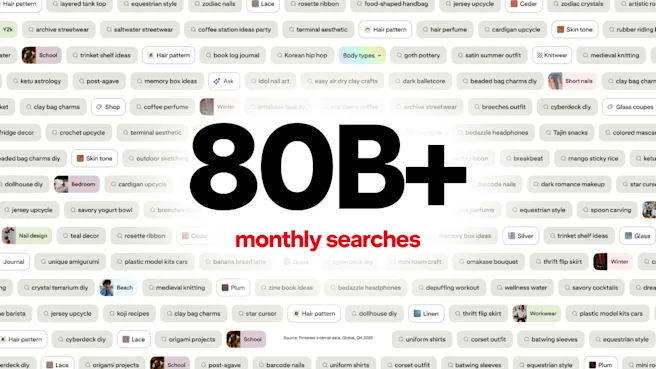
Pinterest today is a fundamentally different platform than it was just a few years ago. It's now a powerful visual search and shopping engine. People make more than 80 billion searches here every month.3 The vast majority are visual. More than half are commercial.4 And over 96% of searches are unbranded.5
That matters because people arrive at Pinterest with clear intent, but before they’ve made up their mind about what to buy. That is the magic moment for a marketer to meet a potential customer.
For much of our history, Pinterest was a great place to build awareness, but not to drive results. I'm proud to say that Pinterest is now a performance platform, and today we're going to show you exactly how.
AI is powering all of it, and is trained on the totally unique human curation that occurs on Pinterest. A shopping experience that’s more actionable at every step, where AI is helping people refine their style, taste and interests. And an ads platform that’s more relevant, more measurable and easier to use.
It’s all built to help people make decisions, then get back to their lives.
I’ll close by saying this. The best technology should make our lives bigger, not smaller. It should help people get out and do more of what matters to them. It should allow for more genuine human connections, not replace them.
People are looking for technology that feels useful, personal, and human. Where the technology serves the user, not the other way around. We bet on that years ago. And people are showing us every day that they’re yearning for something different, and that we’re on the right track.
At the same time, brands are looking for people who are ready to decide what to try, buy or do next. Pinterest brings them together. So thank you for your partnership. Thank you for investing in a more positive alternative for all of us.
You can read more about the news delivered at Pinterest Presents here.